Vintage repair · 7 min read
Is my old Sub-Zero worth repairing, or should I just replace it?
A 20–35 year old built-in Sub-Zero is usually worth saving in Santa Rosa — the steel cabinet outlasts the sealed system, and what fails is a serviceable part.
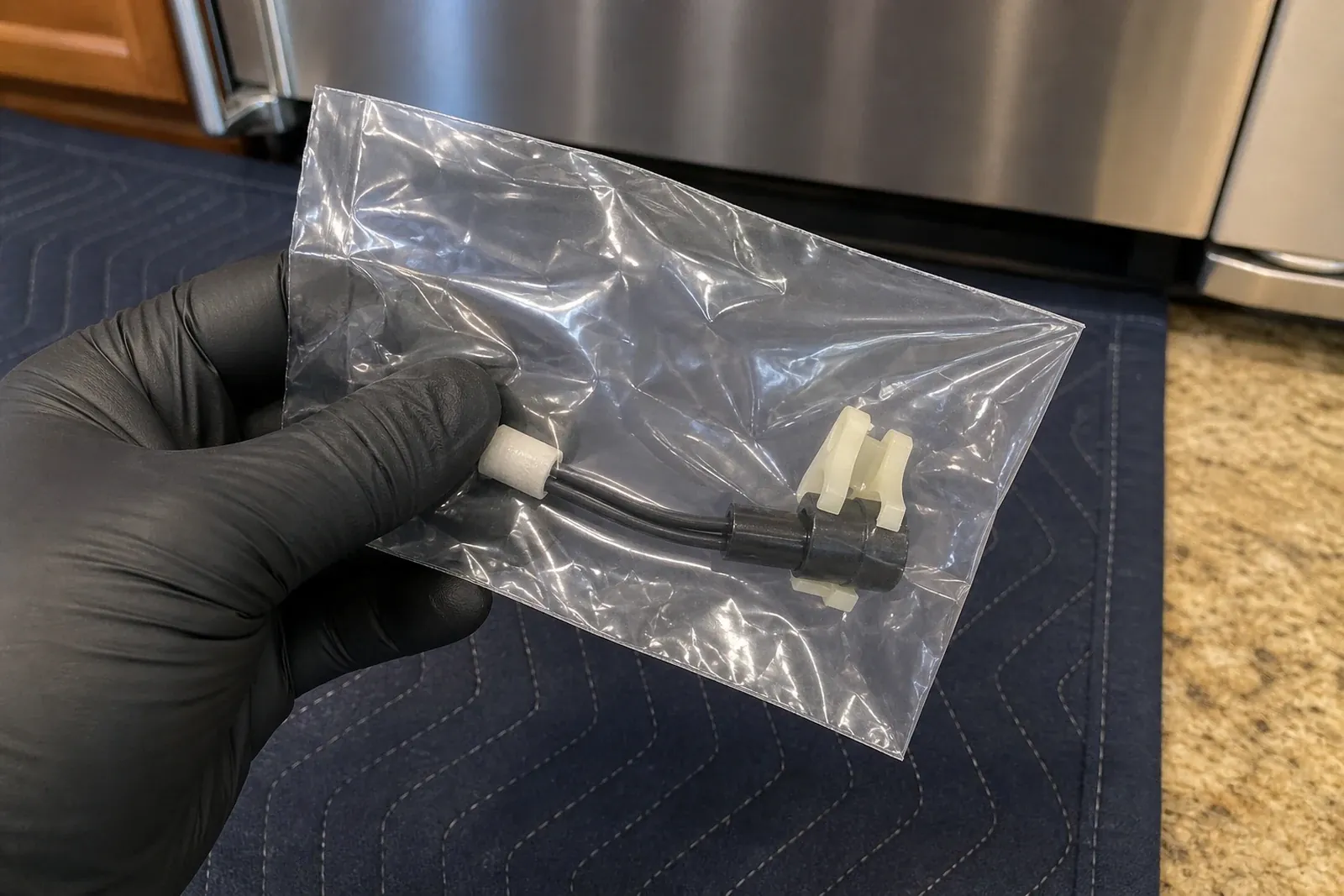
Yes — a 20 to 35 year old built-in Sub-Zero is usually worth repairing. The steel cabinet, foam insulation and stainless frame outlast the sealed system by decades, so what actually fails is almost always a serviceable component, and Sub-Zero stocks genuine parts roughly 15 to 20-plus years past discontinuation.
We see these older units everywhere in Santa Rosa — the original 1990s built-ins in Oakmont and Bennett Valley, the survivors that came through the Coffey Park rebuilds. The honest answer is that most are worth saving. The one case where replacement can genuinely win is a major sealed-system failure on a very old box, and below we'll show you exactly where that line sits instead of hand-waving past it.
What ages well, and what doesn't
Think of a vintage Sub-Zero as two appliances sharing one frame. The first is the cabinet — heavy-gauge steel, dense foam insulation, a stainless interior and the door hardware. That half barely ages. We pull grilles on 30-year-old units in Rincon Valley that are structurally as sound as the day they were installed; nothing about the box itself wears out on a normal timeline.
The second appliance is the sealed system and its supporting parts — the compressor, evaporator, condenser, fans, defrost components, gaskets and (on later units) the control electronics. These are the things that fail with age, and the important point is that nearly every one of them is a serviceable, replaceable component, not a reason to scrap the cabinet. A torn door gasket, a tired condenser fan, a clogged condenser, a failed defrost heater or an ice-maker fault are all bounded repairs on parts Sub-Zero still makes.
That parts availability is the quiet reason these units stay fixable. Sub-Zero supports its built-ins long after they leave the catalog, so gaskets, fans, heaters, controls and compressor kits for a 1990s 500-series unit are generally still stocked. We work from genuine OEM parts and read the model and serial off the data plate first — if you're not sure where to look, our model number guide and the data-plate photo checklist walk you through it.
The dual sealed system most owners don't know they have
Here's the detail that surprises people the most. On the combination Sub-Zero built-ins — the over-and-under models with the refrigerator on top and the freezer below — there are usually two completely separate cooling systems inside one cabinet: two compressors and two evaporators, one dedicated to the fresh-food side and one to the freezer. Sub-Zero did this so each compartment could hold its own ideal temperature and humidity independently.
The practical consequence catches owners off guard: one side can fail while the other runs perfectly. Your freezer can stay rock-solid at zero while the refrigerator drifts into the 50s, or the reverse — and that's not a contradiction, it's two systems behaving independently. Far from being bad news, it's often the best news in the diagnosis, because it means the fault is isolated to one half of the unit, and the repair is bounded to that side rather than the whole machine.
So when a vintage Sub-Zero is "warm on one side, fine on the other," don't assume the whole thing is dying. That pattern points us straight at a single side's sealed system or compressor, a fan, or a defrost fault. The single-compartment all-refrigerator and all-freezer models are the exception — those run one compressor — but the tall combination units are the ones where this independence really matters.
Symptom to likely cause on a vintage built-in
None of this replaces a real diagnosis, but here's how the common complaints on an older built-in usually sort out, so you can place your own unit on the map before we arrive.
| What you're seeing | What it usually means |
|---|---|
| Condensation on the door, runs constantly | Hardened or torn door gasket — the number-one failure after about 20 years |
| One compartment warm, the other fine | A fault isolated to that side's sealed system, fan or defrost — not the whole unit |
| Both sides slowly losing cold, long run times | A clogged condenser or a sealed-system refrigerant leak (often a corroded evaporator coil) |
| Uneven frost, ice building where it shouldn't | A defrost-system fault — drain, heater or defrost thermostat |
| New rattle, hum or buzzing | A worn condenser or evaporator fan motor, or a tired compressor |
Note what's missing from that list on the oldest units: error codes. The mechanical 500-series built-ins use a simple dial thermostat and have no control board and no diagnostic codes at all — electronics didn't arrive until the 600 series. If your unit does throw a code, that's useful information, and our error-codes overview covers what those mean. For a unit that's simply gone warm, start with the not-cooling diagnostic.
The honest repair-or-replace line
Most of the time the math is lopsided in favor of repair. A new built-in Sub-Zero runs, by industry estimates, somewhere around $13,000 to $15,000 installed. Against that, the everyday repairs — a gasket, a fan, a defrost part, a control on a sound cabinet — aren't a close call. When the cabinet is solid and the failure is a serviceable component, fixing it is clearly the better spend, and that's the situation with the large majority of vintage units we see across Santa Rosa.
The sealed system is where age earns a frank conversation. A major sealed-system or compressor repair on these units lands, again by industry estimates, roughly in the $900 to $3,000 range depending on the fault — those are general figures, not our quote. On a newer unit that's still an easy yes. On a 30-year-old box, when you stack a major sealed-system repair against a $13,000-plus replacement, it usually still favors repair on a structurally sound cabinet — but not always, and we won't pretend otherwise. If the compressor is failing and other components are tired too, replacement can be the smarter long-term call, and we'll put the readings in front of you. There's more on weighing it in our repair-or-replace guide.
One more vintage-specific wrinkle worth flagging: refrigerant. A 500-series unit may run on R-12 or R-134a depending on its build date, and any sealed-system work is professional-only, EPA Section 608-certified handling — never a homeowner job. If yours is an early-90s unit, our pieces on the 500 series and the R-12 to R-134a conversion go deeper. The simplest next step is to let us read the data plate and put gauges on it: every visit starts with an $89 diagnostic that goes toward the repair, so the recommendation rests on real numbers. Call (628) 209-6820 or book online and we'll give you a straight answer on your unit.
FAQ
Questions & answers
Is it worth repairing a 25-year-old Sub-Zero refrigerator?
Usually yes. The steel cabinet and insulation easily outlast the sealed system, so what fails is almost always a serviceable part — a gasket, a fan, a defrost component or a control — and Sub-Zero still stocks parts for these units. The only case where replacement can win is a major sealed-system failure on a very old box, and we'll show you the numbers honestly before you decide.
Why is my old Sub-Zero warm on one side but fine on the other?
Most combination Sub-Zero built-ins have two separate cooling systems — two compressors and two evaporators, one for the refrigerator and one for the freezer. They run independently, so one side can fail while the other stays perfect. It's not a whole-unit failure; it points to a fault isolated to that one side, which usually means a bounded repair.
Can you still get parts for a 1990s Sub-Zero?
Generally, yes. Sub-Zero supports its built-ins roughly 15 to 20-plus years after a model is discontinued, so genuine gaskets, fans, heaters, controls and compressor kits for 1990s 500-series units are usually still available. We work from OEM parts and confirm the exact model and serial off the data plate before ordering.
Guides
More Santa Rosa guides
Next step
Rather leave it to a specialist?
Call with the Sub-Zero or Wolf model number and current temperatures for a flat quote before any visit.