Symptom guide · Santa Rosa
Sub-Zero freezer not freezing in Santa Rosa: read the split before the part
A freezer that softens ice cream or stops making solid cubes is alarming, but the fix is usually airflow rather than a dead compressor. The first question is which compartment is actually warm, because on a Sub-Zero that single fact points at completely different parts.
4.9/5 · 837 verified customer reviews
Sub-Zero built its reputation on dual refrigeration: two separate sealed systems, one for the fresh-food side and one for the freezer, each with its own evaporator and fan. That design is the very thing that makes a warm-freezer diagnosis straightforward. If only the freezer has lost its chill while the refrigerator above holds fine, you can rule out a great deal before anyone opens the cabinet, because the two boxes do not share the cooling part that would have failed.
What looks like a freezer failure in Santa Rosa is most often a freezer that cannot get rid of heat. The compressor and the coil are usually fine; the airflow around them is not. Between dry inland summers that push past 95°F and the dust and ash that settle on hillside lots, the condenser is the part most likely to be quietly strangling the system. The checks below sort the cheap, common causes from the rare expensive one.
Reading the split
Freezer-warm versus both-sides-warm
Local pattern
Why Fountaingrove and Skyfarm freezers warm first
Elevation and exposure decide a lot here. The custom homes on the Fountaingrove and Skyfarm ridges sit in open, dry terrain where afternoon sun bakes the kitchen wall and a steady drift of fine soil rides the wind onto every intake. A built-in tucked into millwork on one of those ridges loads its condenser far faster than the same model in a shaded flatland kitchen near Spring Lake or Bennett Valley. When a freezer there starts to warm in late summer, the coil is the first thing we expect to find packed.
Wildfire season compounds it. The smoke events that have become part of Sonoma County life since 2017 lay down a layer of ultra-fine ash that no household routine catches, and it migrates straight to the condenser fins. A freezer that was holding 0°F in June can be sitting at 14°F by October purely because the coil can no longer shed heat. Garage and outdoor Sub-Zero units take the worst of it, fighting both ambient heat and ash with no conditioned air around them. That is why our seasonal advice and the wildfire-condenser guide both push coil cleaning before and after smoke, and why we read the condenser before we ever suspect the compressor.
Before you book
Four owner-safe checks
- Write down both compartment temperatures. Put a thermometer in the freezer and another in the fresh-food side and read them after an hour. The single most useful clue is whether only the freezer is warm or both sides are drifting; they lead to completely different parts. A freezer above 10°F with a normal fresh-food side narrows the search immediately.
- Pull the lower grille and look at the condenser. Slide off the toe-kick grille and check the coil and the condenser fan behind it. On the Fountaingrove and Skyfarm ridges, fine hillside dust and wildfire-season ash blanket that coil within a season, and a smothered condenser is the leading reason a Santa Rosa freezer slowly loses its edge. Brush and vacuum it, and confirm the fan spins freely.
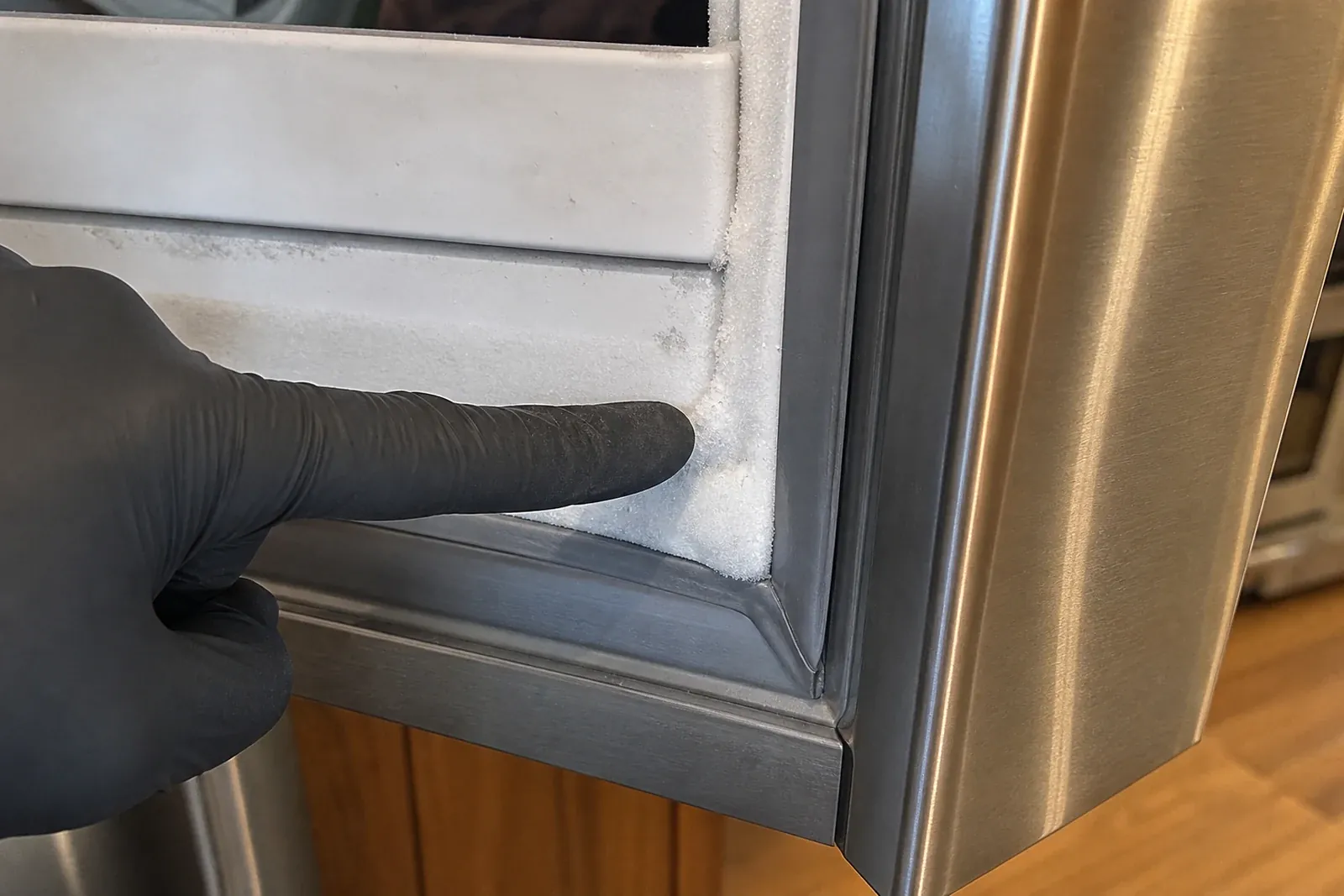
- Check the rear freezer wall for a frost slab. Empty the top freezer basket and look at the back panel. A thick, uneven sheet of frost is a sign the defrost system has stopped clearing the evaporator, which chokes airflow and lets the box warm even while the compressor runs. Smooth, light frost is normal; a packed slab is not.
- Stop adjusting and give it a full day. Resist dropping the setpoint over and over; it hides the pattern and can ice the evaporator further. Clean the coil, close the door, and log the freezer temperature across 24 hours. A unit that recovers tells you it was airflow; one that stalls warm needs a technician.
When to stop DIY
Where owner steps end
Cleaning the condenser path and confirming the door seals are reasonable owner moves. Stop there. Do not add refrigerant, do not bypass a thermistor, and do not keep resetting an alarm that returns; those actions erase the evidence a technician needs and can turn a fan repair into a compressor conversation. If frozen food is at risk, move it and book promptly.
Where the equity leads
If both sides are warm after a clean coil, the next read is the sealed system and compressor. For a warm fresh-food side instead, start at the not-cooling diagnostic. Seasonal coil care is covered on the wildfire-season condenser and Fountaingrove dust and heat pages.
FAQ
Warm-freezer questions from Santa Rosa owners
My Sub-Zero freezer is warm but the fridge is fine. What does that mean?
On a Sub-Zero with dual refrigeration each compartment has its own sealed evaporator, so a warm freezer with a normal fresh-food side points squarely at the freezer's own airflow path: a stalled evaporator fan, a defrost fault icing the coil, or a thermistor misreporting the temperature. It is rarely the compressor when only one side drifts. A single-evaporator model behaves differently, which is why the model tag matters before any part is named.
Why would Santa Rosa heat and wildfire smoke make the freezer warm?
The freezer can only stay cold if the condenser can dump its heat outside the cabinet. During a Santa Rosa heat stretch the coil already works hard, and Fountaingrove, Skyfarm and Mark West sit in dust that packs the fins fast. Wildfire-season ash makes it dramatically worse, coating intakes in days. A blanketed coil lengthens run times and lets the freezer creep up even though nothing is mechanically broken; cleaning it often restores the box.
How cold should a Sub-Zero freezer be?
Aim for 0°F, with anything at or below 5°F acceptable for solid freezing and good ice. Once the freezer drifts past about 10°F, ice cream softens, the ice maker produces hollow cubes, and frozen food begins to lose quality. If your logged readings sit consistently above that, treat it as a real fault rather than a temporary door-open recovery.
Could a bad defrost system be why my freezer is not freezing?
Yes, it is one of the most common causes. When the defrost heater, thermistor or control fails, frost is never cleared from the evaporator and grows into a slab that blocks the fan's airflow. The compressor keeps running but cold air cannot reach the food, so the box warms with ice visibly building at the back wall. A technician confirms the heater, sensor and control before any part is replaced.
Is a warm freezer a sealed-system or compressor problem?
Sometimes, but it is the expensive exception, not the first guess. If both the freezer and the fresh-food side are warming and the compressor runs almost constantly after the condenser is clean, the conversation moves to refrigerant charge and the sealed system. That diagnosis needs gauges and amp-draw readings on site; you can read how we approach it on the sealed-system and compressor page before assuming the worst.
How much does a freezer-not-freezing repair cost in Santa Rosa?
Most warm-freezer repairs are airflow or part-level work, covering an evaporator fan, a defrost component, a thermistor or a condenser service, and generally run $280 to $640. Sealed-system or compressor work is a separate category at $900 to $1,800 and only after airflow is ruled out. The $89 diagnostic is credited toward the repair once you approve a flat-rate quote.
Related
Next step
Get the freezer holding again
Send your model tag and both compartment temperatures, and we will route the visit around the likely part instead of a generic appliance script.