Symptom guide · Santa Rosa
Sub-Zero leaking water in Santa Rosa: tracing the puddle to its source
A built-in that leaves water on the kitchen floor is almost never losing refrigerant. It is shedding plain water, and inside a sealed Sub-Zero that water comes from a short list of places. Working out which one before you book turns a guessing game into a single-trip fix.
4.9/5 · 1,356 verified customer reviews
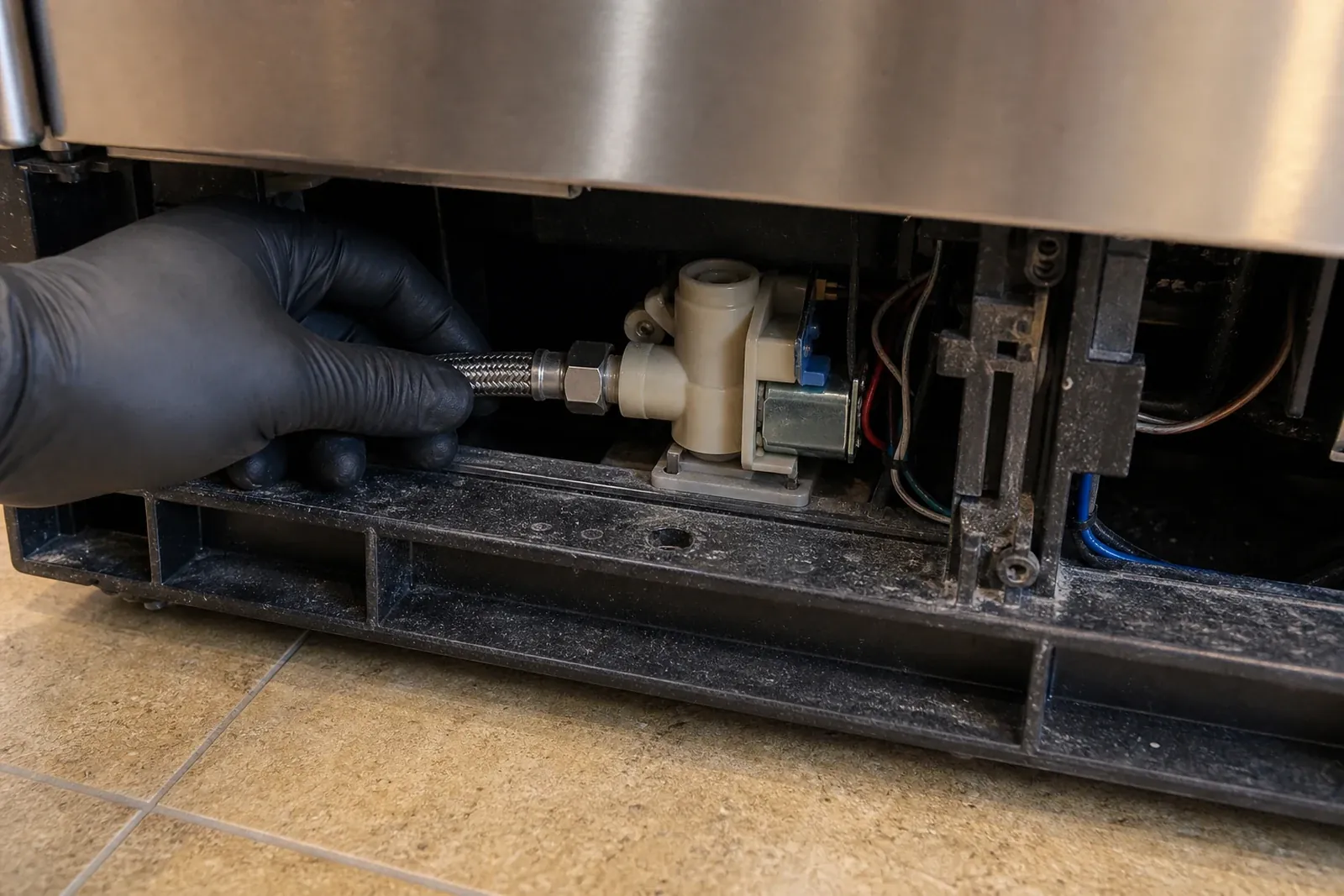
When a Santa Rosa homeowner spots water beside the Sub-Zero, the first fear is usually the compressor or a refrigerant problem. The reassuring part is that the cooling charge lives in a welded loop, sealed at the factory, that never weeps onto your floor; a puddle is ordinary water, and that almost always points to a smaller, cheaper repair. The whole job is figuring out which of a handful of sources is responsible, because each one leaves a slightly different signature.
Reading that signature matters more in this city than in many. A trickle that would be a shrug on a tiled tract-home slab becomes real damage in the older houses west of Highway 101, where original fir and redwood floors lie straight over an open crawlspace with none of the moisture barriers a modern build would carry. Catching the source early is the line between a quick mop and a floor-refinishing estimate.
Where it starts
The four places the water is really coming from
Local pattern
Why Santa Rosa's water and old floors change the stakes
Two local realities shape leak calls in this city. The first is the water itself. Sonoma Water supplies most of Santa Rosa from the Russian River well field near Wohler, and that supply is moderately mineralized. Over the years those minerals build a chalky scale inside the ice-maker solenoid and along the fill line, narrowing the passage and stressing the fittings until one finally seeps. If your dampness collects at the back of the cabinet near the valve rather than on the freezer floor, scale on the feed line is the prime suspect, and it is the same mineral load behind slow, hollow ice.
The second is the housing stock. In Railroad Square, along the McDonald Avenue mansion row, in the West End and through the Burbank and Junior College neighborhoods, kitchens sit in Victorians and Craftsman bungalows built before the First World War. Their plank floors are old-growth fir and redwood laid over a ventilated crawlspace, and a slow leak wicks into the grain and the joists long before a visible puddle appears. By contrast, the rebuilt slab homes in Coffey Park and the Fountaingrove hills hide the opposite problem: water spreads flat under engineered flooring and surfaces a cabinet away from the refrigerator. Either way, the timing and towel checks below are the fastest route to the source before any wood or finish is harmed.
Before you book
Four owner-safe checks
- Rule out refrigerant and clock how fast it returns. Because a sealed Sub-Zero physically cannot drip its cooling charge onto your floor, whatever you mop up is water. Dry the spot completely, rest a flat dishtowel where the cabinet base meets the floor, and check it against a clock. A patch that re-wets every couple of hours is riding the defrost schedule; one that stays steadily damp is coming off the supply side.
- Look for a low ice shelf on the freezer floor. Open the freezer and study the floor of the bottom basket area. A shallow pane of ice, or a beaded ring of frost around the small drain opening at the rear, means the defrost channel has plugged and the melt is escaping forward. This internal cause is behind most of the leak calls we take across town.
- Trace the feed line back to its shutoff. From behind the cabinet, follow the plastic or copper feed line to the inlet solenoid and on to the household shutoff in the sink base or the adjoining cabinet. A whitish crust on a fitting, a wet collar on the valve, or a forming bead at a joint says the escape is plumbing, and Russian-River mineral crust is a common reason an aging joint finally gives.
- Tug-test the door seal for hidden sweat. Shut the door onto a banknote and pull it loose; if it releases with no grip anywhere along the run, the gasket is admitting moist room air that condenses on the chilled liner and beads its way down. On Sonoma County's grey coastal mornings a slack seal can sweat enough to pass for a genuine leak.
Stay safe
What not to do while you wait
- Resist chipping at the ice shelf or pouring hot water in to melt it; either can split the liner or fracture the drain line.
- Do not keep working the dispenser hoping a supply seep will flush itself clear.
- Skip the tape or putty on a damp fitting; sealing the surface only hides the leak and pushes the water elsewhere.
- Never let water stand on a hardwood floor overnight; pull rugs and lay towels until we arrive.
What the visit settles
On site we flood-test and watch the defrost channel, inspect the tray and the condenser fan, and put the inlet solenoid and fill line under pressure, so the water and its cause both leave with the truck. The majority of leak repairs are component-level and stay well under the price of a cooling-system job.
See Santa Rosa repair cost ranges →Related causes
If the leak comes with other symptoms
Water rarely travels alone. If the puddle arrives with hollow cubes or a slow tray, the shared culprit is usually the ice-maker feed line. If you also see a frost or sweat line at the door, read the door gasket and seal repair page. And if scale keeps returning on your valves and filters, the Santa Rosa hard-water guide explains why local water is the recurring thread.
FAQ
Leaking-water questions from Santa Rosa owners
Should I worry, or pull the plug, when my Santa Rosa Sub-Zero leaks?
What you are wiping up is water and never refrigerant, so there is no toxic exposure. The real risk is the floor underneath. In the pre-war homes around Railroad Square and the McDonald Avenue mansion row, original fir and redwood planking drinks up a slow leak and cups long before a visible puddle forms, so act quickly. Close the supply valve in the sink cabinet if you cannot find the drip, dry everything down, and book a visit. Unplugging the unit is only necessary once water has reached the electrical receptacle.
Why does the leak get worse in late summer?
Damp ocean air funnels inland each morning through the Petaluma Gap and up the Russian River corridor, and that moisture is exactly what the defrost system has to evaporate. When the drain channel ices over, the heavier airborne humidity of August and September overwhelms it sooner, and a tired door seal sweats more in the same air. The puddle looks worst in those months even though the underlying fault is identical the rest of the year.
Is Santa Rosa's hard water part of the problem?
It often is. Most of the city's tap water is drawn from Sonoma Water's Russian River wells near Wohler, and that moderately mineral-rich supply lays a chalky film inside the ice-maker solenoid and the slim fill line over the years. The buildup squeezes the passage and fatigues the joint until it weeps. When the dampness collects at the rear near the valve rather than on the freezer floor, scale on the feed line is the prime suspect, and the hard-water guide covers how to slow it down.
Can I keep running the refrigerator until a technician comes?
Usually, yes. A plugged defrost channel or a slow seep at the fill line will not put your food at risk, so leave the doors shut and blot the floor as needed. The one exception is a steady supply-side drip you cannot stop at the valve; if the house will sit empty, shut the main water line as a precaution. Lift any rugs and slide wooden furniture clear of the damp zone while you wait.
There is also a thick wall of ice at the back of the freezer. Connected?
Yes, that is the source end of the same chain. Once the defrost circuit stops clearing the coil, frost stacks into a wall on the rear panel; as part of it thaws, the overflow defeats a drain that can no longer keep pace and ends up on the floor. We check the defrost heater, the sensor and the drainage route as a single job, so the ice wall and the puddle are both resolved instead of merely mopped.
What does a leak repair run in Santa Rosa?
Most of this is component-level work. Thawing and re-routing a frozen defrost line, or replacing a fill tube or inlet solenoid, usually lands between $230 and $540, though a split drip tray or a dispenser line can cost more. The diagnostic call is $89 and comes off the repair once you approve it. The Santa Rosa cost page lists planning figures by job type.
Related
Next step
Stop the puddle in Santa Rosa
Tell us where the water shows up and whether it returns on a rhythm, and we will bring the drain, feed-line and tray parts to settle it in one visit.