4.9/5 · 1,008 verified customer reviews
Santa Rosa · water chemistry
The Santa Rosa hard-water guide to Sub-Zero ice makers
Sonoma County tap water is moderately hard, and that single fact explains most of the slow, hollow and cloudy ice we see across Santa Rosa Sub-Zeros. This is an owner's guide to the mineral side of ice making — what scale does, how often to swap a filter, and the point where it stops being water and starts being the module.
Direct answer
Santa Rosa's moderately hard water scales the inlet valve and clogs the filter on a Sub-Zero ice maker, starving the mold and producing slow, hollow or cloudy cubes. Replace the filter every 6–9 months here, not the 12 the manual assumes. If a fresh filter and confirmed pressure don't restore full cubes, the valve or module is next. Book at (628) 209-6820.
The chemistry
What 'moderately hard' actually means for your ice
Water hardness is just dissolved minerals — mostly calcium and magnesium carbonate — measured in grains per gallon or parts per million. Much of Santa Rosa's supply, whether it arrives from the Sonoma County aqueduct system or a Fountaingrove and Mark West hillside well, lands in the moderately hard band. You won't taste it in a glass, but an ice maker freezes that water dozens of times a day, and every cycle leaves a trace of mineral behind.
Two things happen as a result. First, minerals plate out on warm metal surfaces — the brass inlet valve and its tiny metering orifice — the same way scale builds inside a kettle. Second, the sediment and dissolved load shorten the working life of the carbon-block water filter that feeds the dispenser and ice mold. Neither failure is dramatic. Both creep, which is exactly why owners blame the ice-maker module long after the real culprit took hold upstream.
It helps to picture the journey water takes inside the cabinet. It enters through a shutoff and a small line, passes through the inlet valve that meters each fill, runs through the filter that strips sediment and taste, travels up a fill tube into the freezer compartment, and finally drops into the mold to freeze. Hard water touches every stage of that path, but it does its slowest, most permanent damage at the two narrowest, warmest points — the valve orifice and the filter media. Understanding that path is what lets you fix the right thing instead of guessing.
Reading the cube
Hollow, slow and cloudy cubes are water-first symptoms
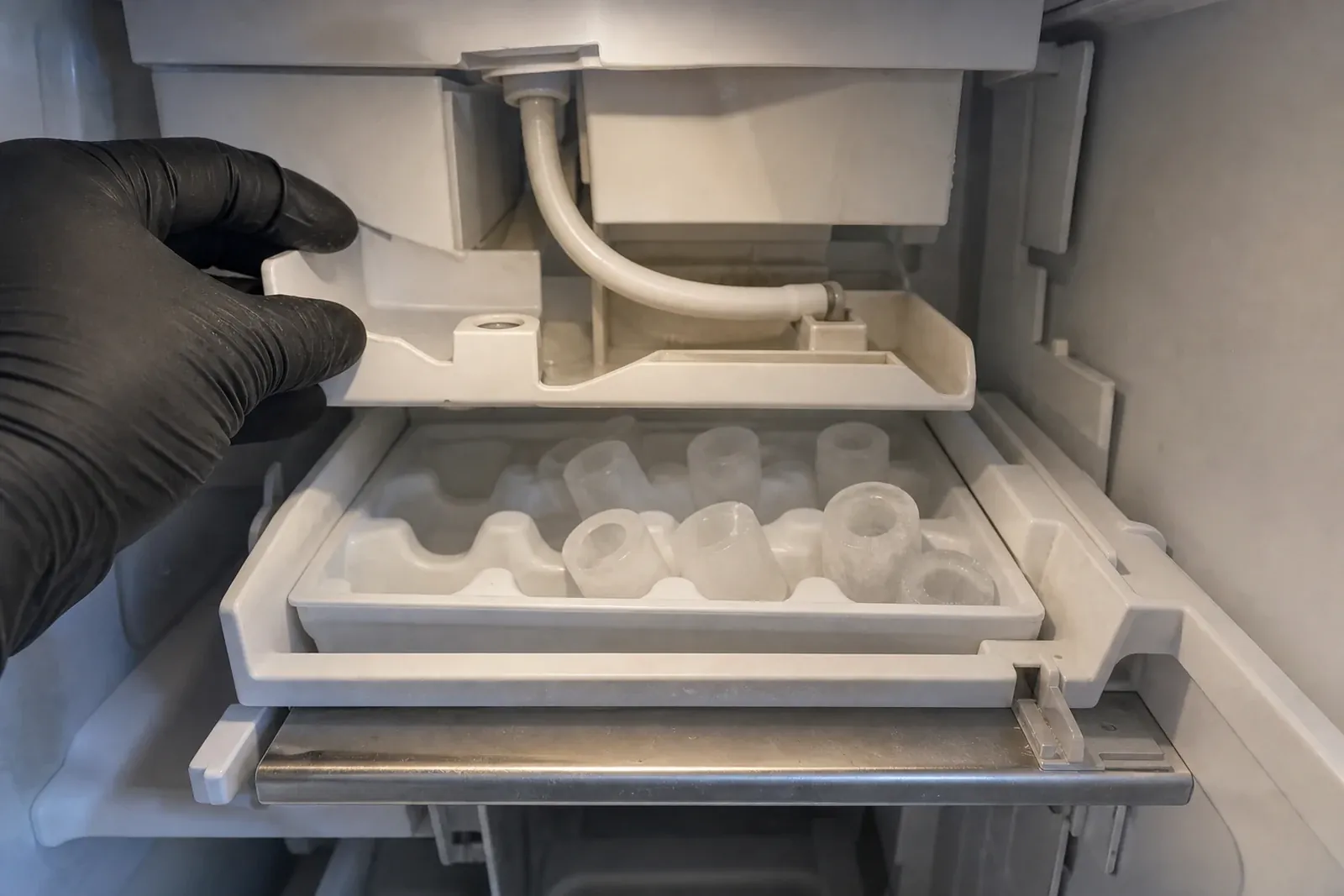
Sub-Zero molds are sized for a full, clear cube produced on a predictable schedule. When the water side is restricted, the cube tells on it before any error code does. A hollow or undersized cube means the mold isn't filling completely — a metering valve choked with scale, a clogged filter or low household pressure is delivering too little water per cycle. A slow production rate (a half-full bin when it used to be full) points the same direction. Cloudy or white-flecked cubes are the most literal hard-water tell: those are the very minerals we've been describing, frozen into the ice.
The trap is that all three symptoms also overlap with a genuine module or optics fault, so the order you investigate matters. We check water supply, filter age and freezer temperature before we ever quote a module, because replacing the module on a starved water line is the most common way Santa Rosa owners end up paying twice. Cube shape is your first free diagnostic — read it before you call anyone.
There's a timing tell, too. Hard-water restriction comes on gradually: the bin takes longer to fill week over week, cubes shrink by degrees, taste drifts. A failed module or a frozen fill tube tends to be more abrupt — ice was normal, then it stopped. If you can remember roughly when the change started and how fast it progressed, that history narrows the diagnosis before a technician ever opens the freezer. Owners in Oakmont's panel-ready BI-36 and BI-48 columns often notice it first because their units are visually identical and the difference in output between two homes stands out.
| What you see | Most likely hard-water cause | First move |
|---|---|---|
| Hollow / undersized cubes | Scaled inlet valve, clogged filter, low pressure | Replace filter, verify pressure, descale or swap valve |
| Slow production / half-full bin | Restricted flow, filter past life, fill-tube freeze | Filter change first; check fill tube and valve |
| Cloudy or white-flecked cubes | Dissolved minerals (hard water), exhausted filter | Fresh filter; consider pre-filtration if severe |
| No ice at all | Failed valve, freezer too warm, module/optics | Diagnose valve, temperature, then module |
Filter cadence
Why 6–9 months beats the 12-month sticker
Sub-Zero's general guidance of roughly twelve months between filter changes assumes average-to-soft municipal water. Santa Rosa is harder than that baseline, so the same cartridge saturates faster. In practice we tell owners across Rincon Valley, Bennett Valley and Oakmont to plan on a 6 to 9 month cadence, and sooner if you notice flow slowing, taste changing or the cubes shrinking. A filter is the cheapest part in the entire water path; running one to exhaustion to save money usually costs more in callbacks and dispenser strain.
Use the correct cartridge for your model family — Classic BI, Designer and PRO columns, and undercounter units don't all share the same filter — and if you're unsure, the model and serial on the cabinet tag settle it. If your home runs entirely on a hillside well in Fountaingrove or Skyfarm with higher mineral content, tighten that interval further or talk to us about whole-house softening upstream of the refrigerator.
A couple of habits make the cadence stick. Write the install date on the filter with a marker, or set a recurring calendar reminder the day you change it — memory is the most common reason filters run double their life. When you swap one, run two or three batches of ice through and discard them; the first cubes after a change can carry loosened carbon fines and taste flat. And resist the off-brand cartridges sold online: many fit but flow differently or filter less, which quietly reintroduces the very sediment and minerals you're trying to remove. Genuine cartridges are matched to the unit's flow and pressure expectations, and that consistency is part of what keeps cube size correct.
| Your water situation | Suggested filter cadence | Note |
|---|---|---|
| Soft / average municipal (manual default) | ~12 months | Standard cartridge |
| Santa Rosa moderate hardness (typical) | 6–9 months | Watch flow and taste |
| Hillside well, higher minerals | 4–6 months | Consider pre-filtration / softening |
| Heavy use / large household | Shorten by ~2 months | Inspect cube quality monthly |
Upstream of the unit
Inlet valve and water line: where scale lands first
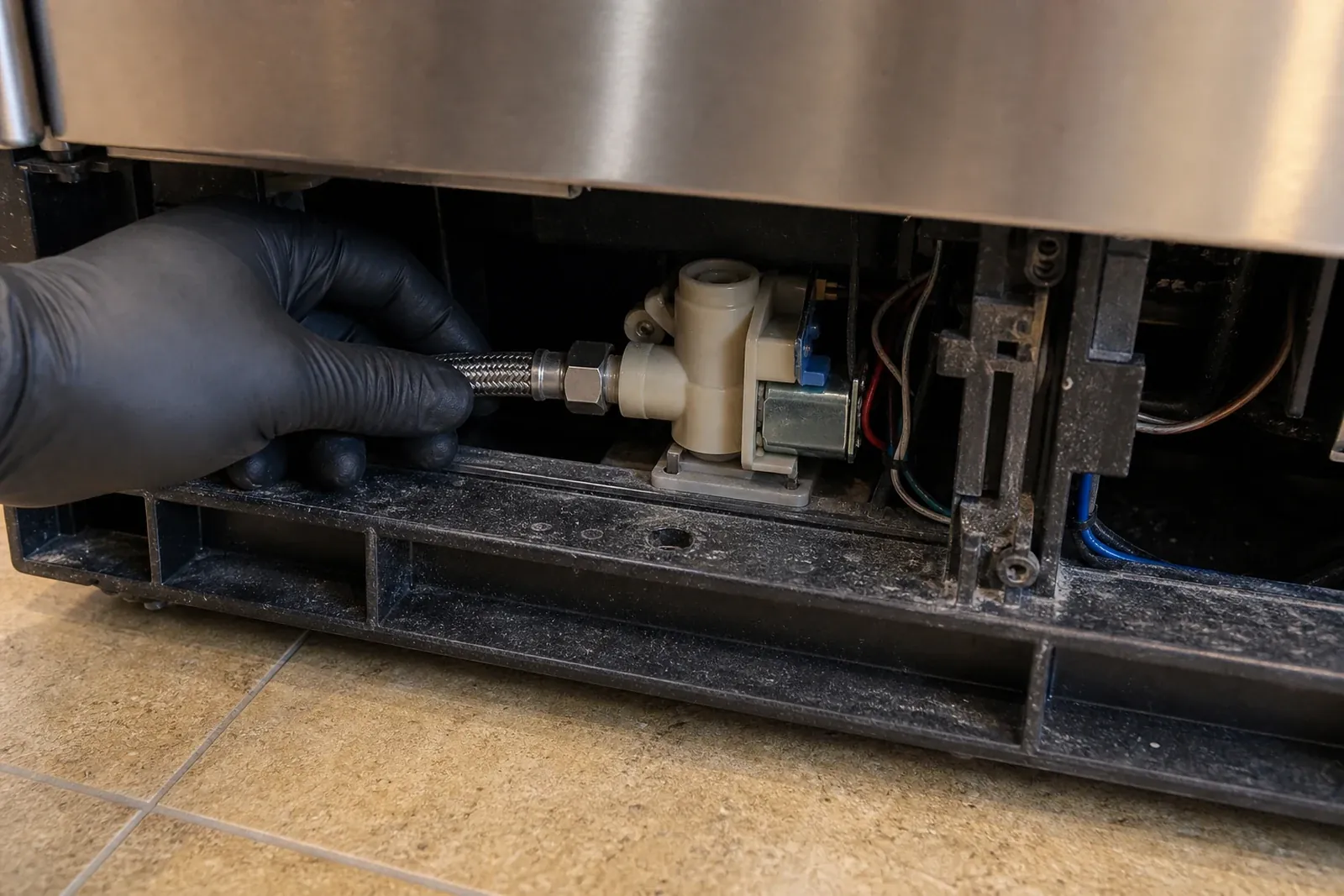
The water inlet valve is an electrically opened brass fitting with a precision orifice that meters exactly how much water reaches the mold each cycle. That orifice is the narrowest point in the system, which makes it the first place scale becomes a problem — a valve that flowed perfectly five years ago can now pass a fraction less water, and the cube shrinks accordingly. A mildly scaled valve sometimes responds to cleaning; a heavily scaled or weak one is replaced with a genuine OEM part so the metering stays correct.
Household water pressure matters too. Sub-Zero ice makers expect a supply in roughly the 35–120 psi range; an older saddle valve, a kinked line behind a tightly built-in cabinet, or a partially closed shutoff can drop pressure enough to mimic scale. On wine-country properties with long runs or booster pumps, pressure can also swing. We verify pressure and filter condition before condemning the valve, and we never cut into a built-in cabinet's water line without protecting the surround.
The fill tube deserves a mention because it sits at the intersection of water and temperature. It's the small line that carries water the last stretch into the freezer to fill the mold, and if it ices up — from a dribbling, scale-restricted valve that leaves residual water to freeze between cycles — the next fill either spills, freezes short, or stops. This is a perfect example of how a hard-water problem upstream masquerades as a freezer or module problem downstream. Clearing the ice without fixing the weak valve only buys a few weeks. We trace it back to the cause, replace the genuine OEM valve when metering is off, and confirm the tube fills cleanly before we close up — the same cabinet-safe approach we bring to every Sub-Zero repair in built-in surrounds.
When it's the module
The point where water rules out and the module rules in
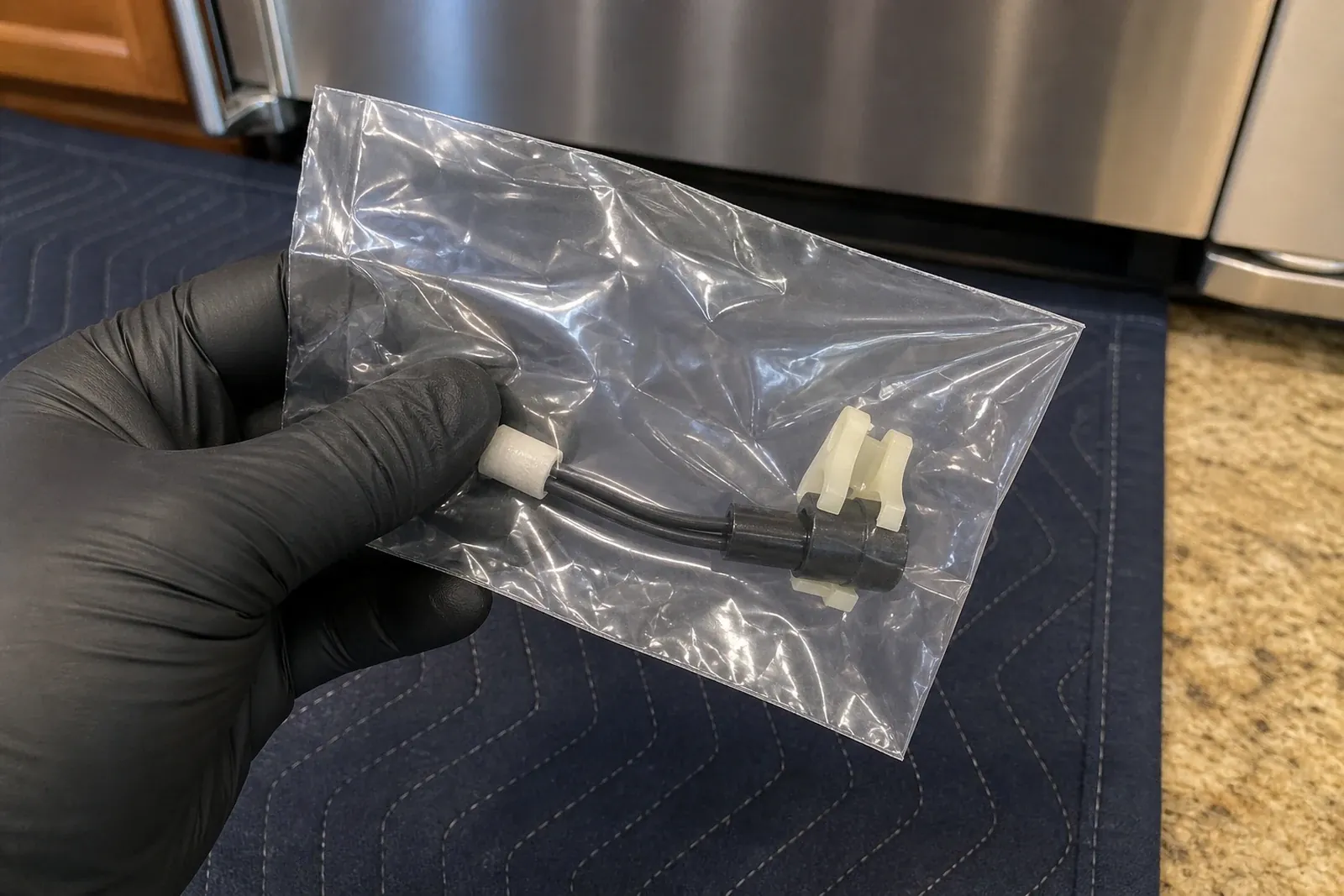
Hard water explains most slow-ice complaints, but not all of them. Once the water side is genuinely clean — a fresh filter, confirmed pressure, an unobstructed fill tube and a freezer holding around 0°F — and the cubes are still wrong, the fault has moved into the ice-maker module itself: the harvest mechanism, the mold heater, the thermostat or, on newer units, the optical sensors that count the bin level. At that stage a module or optics repair is justified, and we'll show you why before quoting it.
This sequence is the whole point of the guide. The module is real, it does fail, and we replace it with genuine parts when the evidence supports it — but it earns the blame only after water, filter, pressure and temperature have been cleared. For the broader symptom-by-symptom walkthrough and the diagnostic logic behind a no-ice call, see our Sub-Zero ice maker and water line page; this guide stays focused on the mineral side that's specific to Santa Rosa's supply.
A quick word on freezer temperature, because it's the one variable owners overlook. An ice maker needs the compartment near 0°F to harvest on schedule; if a stuffed freezer is blocking airflow, a gasket is leaking, or the condenser is choked with the hillside dust and wildfire-season ash common in Fountaingrove and Mark West, the cabinet runs warm and ice slows for reasons that have nothing to do with water. That overlap is why we measure rather than assume. Most hard-water ice repairs — a filter, a descale, an inlet valve — land in the $200–$650 range with a flat-rate quote approved before any work begins, and the $95–$150 diagnostic is credited toward the repair. When you're ready, call (628) 209-6820 or book at our booking page, and folding a filter check into a routine visit is the easiest item on the Sub-Zero maintenance calendar.
Next step
Call with the Sub-Zero model number
Have the model-tag photo, current fresh-food and freezer temperatures, and the symptom timeline ready. That lets the Santa Rosa intake route the visit around the likely Sub-Zero part family instead of a generic appliance script.
FAQ
Questions Santa Rosa homeowners ask before scheduling
Why is my Sub-Zero making hollow or small ice cubes in Santa Rosa?
Almost always a restricted water supply, and in this area hard-water scale is the usual reason. Calcium and magnesium build up on the inlet valve's metering orifice and saturate the filter, so the mold no longer fills completely. Try a fresh filter first; if cubes are still hollow, the valve or pressure is next to check.
How often should I change the water filter on a Santa Rosa Sub-Zero?
Plan on every 6 to 9 months here, not the 12 months the manual suggests for soft-water regions. Santa Rosa's moderately hard water saturates the carbon block faster. If you're on a higher-mineral hillside well in Fountaingrove or Skyfarm, tighten it to 4 to 6 months or add pre-filtration.
Does hard water actually damage a Sub-Zero ice maker?
It doesn't break it overnight, but it shortens the life of the inlet valve and forces the filter to work harder, which is why slow and hollow cubes are so common locally. Scale plates onto the warm brass valve over years. Staying on a tight filter cadence is the cheapest way to protect the rest of the water path.
Why are my Sub-Zero ice cubes cloudy or white-flecked?
Those flecks are dissolved minerals from Santa Rosa's hard water freezing into the cube, often combined with an exhausted filter that's no longer reducing sediment. A new filter usually clears most of it. Persistent heavy cloudiness on well water can warrant upstream softening or pre-filtration.
Should I replace the ice-maker module if a new filter didn't fix slow ice?
Not yet. First confirm water pressure, an unobstructed fill tube and a freezer near 0°F, and rule out a scaled inlet valve. Only when that whole water path is clean and cubes are still wrong does the module or its optical sensors become the suspect. We diagnose in that order so you don't pay for a good module.
Who repairs Sub-Zero ice makers affected by hard water in Santa Rosa?
We do — an independent Santa Rosa Sub-Zero specialist serving Rincon Valley, Bennett Valley, Oakmont and the surrounding ZIPs. We test the water side before condemning parts, descale or replace inlet valves, and use genuine OEM components. Call (628) 209-6820; the diagnostic is $95 to $150 and credited toward the repair.
Related