500 Series · 6 min read
Sub-Zero 500 Series repair guide: the mechanical-era built-ins
The Sub-Zero 500 Series (1987–2003) uses a mechanical dial and no error codes, with dual compressors on combination units. A Santa Rosa repair guide to models, refrigerant and fixes.
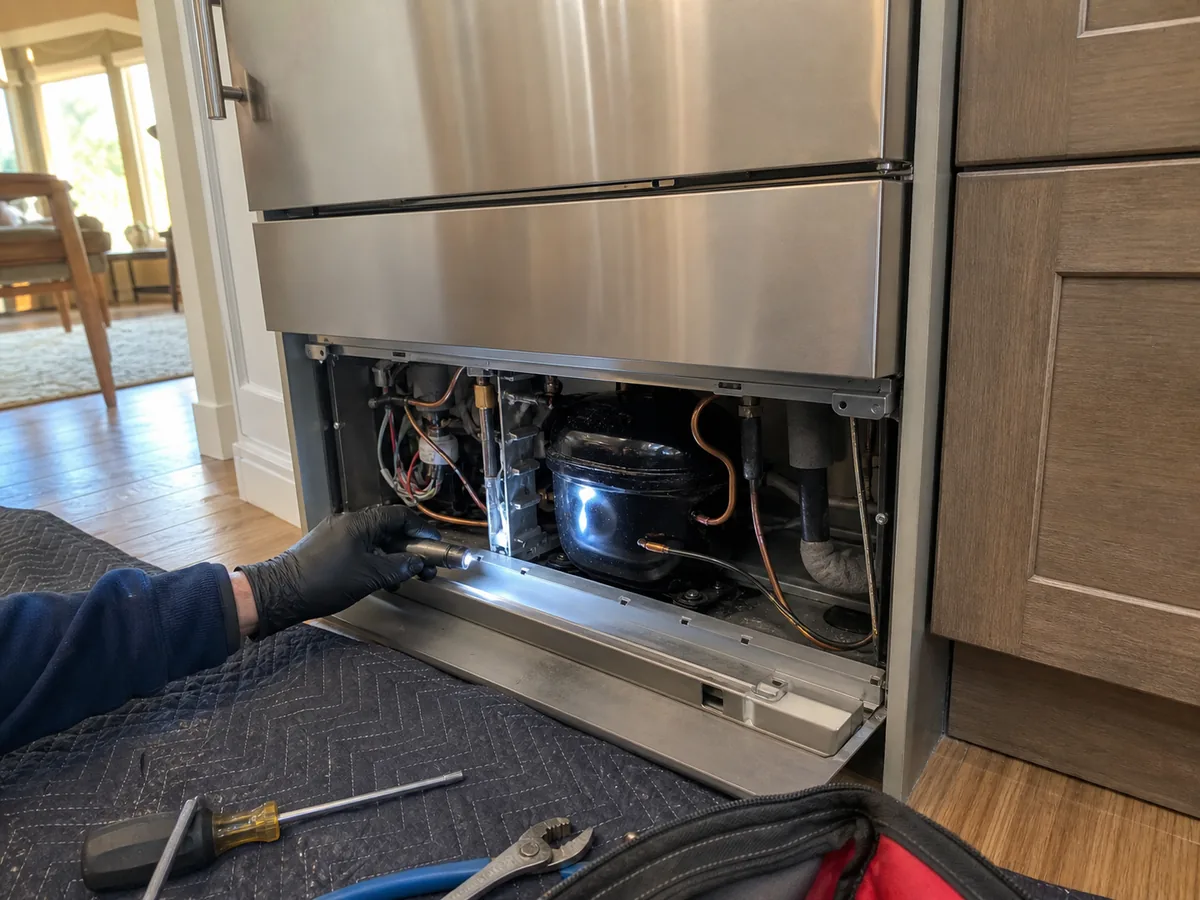
The Sub-Zero 500 Series is the mechanical-era built-in line, produced from 1987 through 2003. You set the temperature with a numbered dial — there is no control board and no error codes — and the combination models run two separate compressors, one for the refrigerator and one for the freezer.
That last point is the one owners in Santa Rosa find most surprising: on a 532, 550 or 561, the fresh-food side can quit while the freezer stays rock-solid, or the reverse, because they are genuinely two independent systems sharing one cabinet. Knowing which side failed — and that there is no diagnostic code to read — is where a sensible repair starts. If you are still confirming what you own, our model-number guide walks you through finding it.
The 500 Series at a glance: a dial, not a code reader
There are two families in the line. The 501R (all-refrigerator) and 501F (all-freezer) are single-compartment units with one sealed system. The rest — 511, 532, 542, 550, 561 and 590 — are combination units in an over-and-under layout, refrigerator on top and freezer below. That over-and-under detail matters because the web is full of a myth that these were side-by-sides; the tall side-by-side column format did not arrive until the 700 series.
| Model | Configuration | Refrigerant | Controls |
|---|---|---|---|
| 501R | All-refrigerator, single compartment | R-12 (pre-1994) or R-134a (1994+) | Mechanical dial, no error codes |
| 501F | All-freezer, single compartment | R-12 (pre-1994) or R-134a (1994+) | Mechanical dial, no error codes |
| 511 / 532 / 542 | Over-and-under, dual compressor | R-12 (pre-1994) or R-134a (1994+) | Mechanical dial, no error codes |
| 550 / 561 / 590 | Over-and-under, dual compressor | R-12 (pre-1994) or R-134a (1994+) | Mechanical dial, no error codes |
The cleanest way to tell a 500 from a 600 is right there in the controls. The 500 is run by a mechanical thermostat — a dial on roughly a 1-to-10 scale, with about 4 to 6 being normal — and there is no electronic control system behind it, so there are no error codes to look up. Electronics, thermistors and diagnostic codes all arrived with the generation that followed. If the badge in your kitchen reads 600-something, or you see a digital readout and the words "VACUUM CONDENSER," read our 600 Series error-code guide instead. For an owner, the missing board is a quiet advantage: no main control board to fail, no firmware to glitch, no sensor drift to chase — when a 500 misbehaves, the cause is mechanical and physical.
Two compressors, two systems — so one side fails alone
The combination 500s (511, 532, 542, 550, 561, 590) carry two compressors and two evaporators — one set dedicated to the fresh-food cabinet, one to the freezer. Sub-Zero built it this way so each compartment holds its own temperature and humidity independently, and the 532 is the model that popularized the design. The single-compartment 501R and 501F have just one compressor.
The practical upshot is the symptom owners call us about: the refrigerator goes warm while the freezer is still frozen hard, or the freezer fails while the fridge stays cold. On a one-system appliance that would be baffling. On a 500 it simply means one of the two sealed systems is in trouble while the other is fine — which often narrows the job before we arrive. Sealed-system and compressor repair on a Sub-Zero is EPA Section 608 work, and our technicians are 608 certified, so refrigerant is handled by law and never vented. Because the refrigerant is a sealed-system question, this is also where the R-12 versus R-134a issue lives.
R-12 or R-134a? Read the data plate, not the model number
Sub-Zero switched the 500 Series from R-12 to R-134a in 1994, and because the line straddles that cutover, the same model can be either one depending on its build date. A 550 or a 561 built in 1992 is R-12; the same model built in 1996 is R-134a. You cannot tell from the model number alone, and there is no published 500-series serial cutoff — so do not trust any chart that claims a clean serial break.
The reliable answer is printed on the unit. The data plate — usually inside the fresh-food compartment along an upper side wall — lists the refrigerant type and charge. Read it, or better, photograph it; our data-plate photo checklist shows exactly which labels to capture so we can confirm refrigerant, model and serial before the visit. If your unit is an R-12 machine and you are weighing your options, the R-12 to R-134a conversion guide lays out the trade-offs honestly — a real conversion is a sealed-system rebuild, not a gas swap.
Common failures, and why a 500 is usually worth fixing
After two to three decades, 500 Series faults fall into a familiar order. Door gaskets are number one — hardened or torn after twenty-plus years, they let warm Sonoma County kitchen air leak in, which shows up as condensation and a unit that runs constantly; that is a bounded gasket repair. Next come sealed-system refrigerant leaks, often at an evaporator coil corroded by decades of defrost cycles, then compressor wear, defrost-system faults (drain, heater or defrost thermostat), condenser-fan and evaporator-fan motors, and ice-maker or water-line issues. A box that isn't cooling usually traces back to one of these.
Here is the case for repair. The steel cabinet, the foam insulation and the stainless frame of a 500 outlast the sealed system by years — what fails is almost always a serviceable component, and Sub-Zero stocks OEM parts well beyond fifteen to twenty years after a model is discontinued, so gaskets, fans, heaters, controls and compressor kits are still obtainable. Set against a new built-in at an industry-estimated $13,000 to $15,000, fixing a sound cabinet is the clear winner in most cases. The honest exception is a major sealed-system failure on a very old unit, where industry repair estimates of roughly $900 to $3,000 can start to rival replacement — and there we will show you the numbers and let you decide, as our repair-or-replace guide explains.
Every visit begins with an $89 diagnostic that goes toward the repair if you proceed, so the quote rests on real readings. If you have a 500 acting up anywhere from Oakmont to Coffey Park, call (628) 209-6820 or book online and we will get a true diagnosis on it.
FAQ
Questions & answers
How do I know if I have a Sub-Zero 500 Series and not a 600?
The fastest tell is the controls. The 500 Series uses a mechanical dial on roughly a 1-to-10 scale and has no error codes or digital readout. If you see a digital temperature display, diagnostic codes, or a "VACUUM CONDENSER" alert, you have the 600 Series. The model number on the data plate confirms it.
Why is my Sub-Zero refrigerator warm but the freezer is still frozen?
On a combination 500 Series model (511, 532, 542, 550, 561 or 590) the refrigerator and freezer run on two separate compressors and evaporators. One sealed system can fail while the other keeps working, so a warm fridge with a frozen freezer simply means the fresh-food system needs attention — not the whole appliance.
Does my 500 Series use R-12 or R-134a refrigerant?
It depends on the build date, not the model number. Sub-Zero switched the 500 Series from R-12 to R-134a in 1994, so the same model can be either. There is no reliable serial-number cutoff — read the refrigerant type printed on the data plate inside the fresh-food compartment, or photograph it and we will confirm it for you.
Guides
More Santa Rosa guides
Next step
Rather leave it to a specialist?
Call with the Sub-Zero or Wolf model number and current temperatures for a flat quote before any visit.