5.0/5 · 1,554 verified customer reviews
Santa Rosa · estate wine storage
Estate wine-cellar cooling service for larger Sub-Zero installations in Santa Rosa
When a Sonoma County home runs more than a single wine column — paired columns, a banked installation, or a built-in cellar wall — cooling problems stop being one-unit problems. Temperature, humidity and airflow now have to agree across an entire installation, and the value at stake is a collection, not a shelf of weeknight bottles.
Direct answer
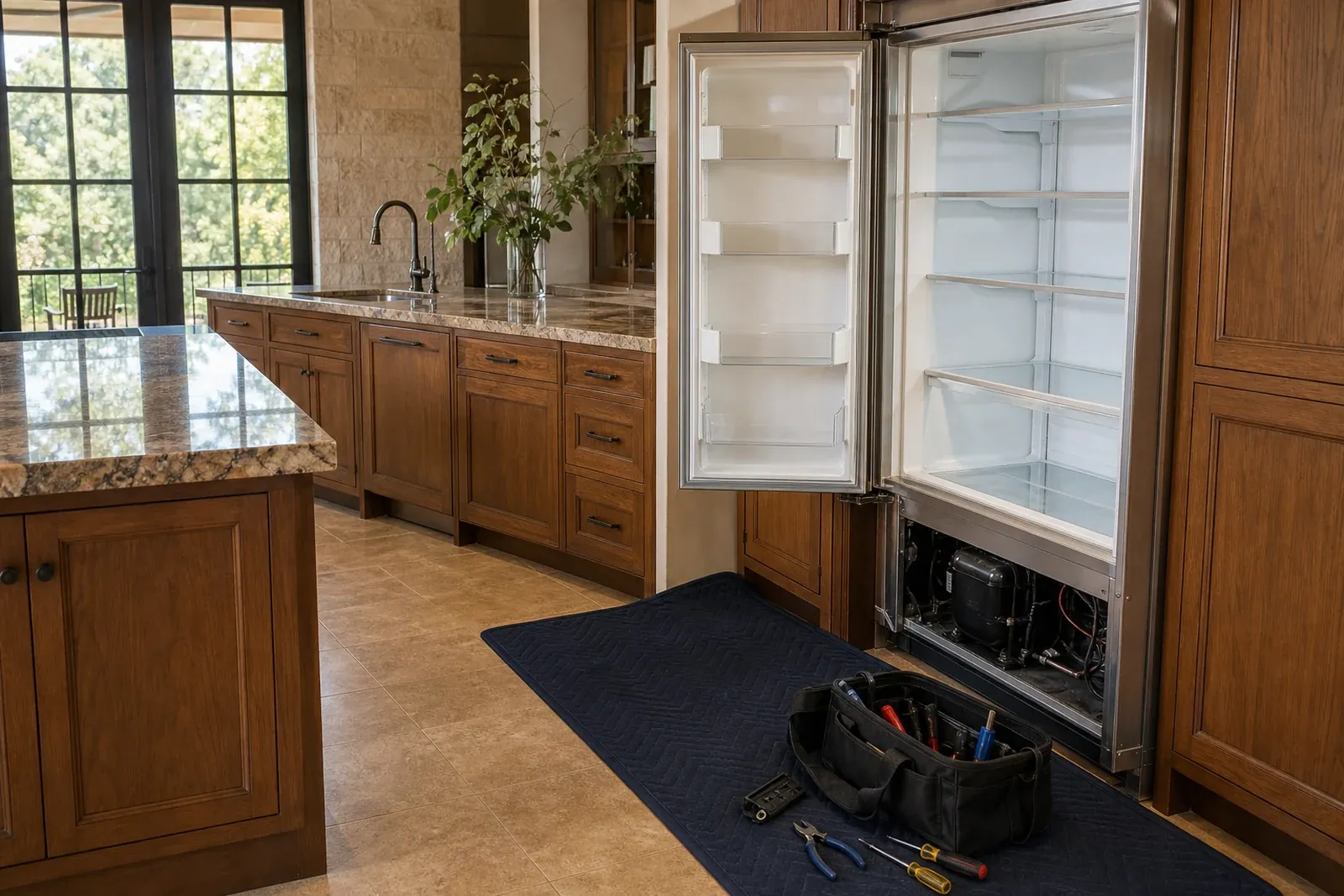
Estate wine-cellar cooling service in Santa Rosa covers larger Sub-Zero installations beyond one column: paired or banked columns, dual-zone units and built-in cellar walls where each zone must hold its band while sharing kitchen heat and humidity. Diagnosis starts with logged readings from every zone, not one display snapshot. Most multi-zone work runs $300–$900. Book at (628) 209-6820.
What this covers
Beyond a single column: what an estate installation actually is
Most wine calls are one column drifting a degree or two — that is its own diagnostic and lives on our wine storage temperature page. This service is for the larger picture: a multi-unit or multi-zone installation where several Sub-Zero wine columns sit side by side, a dual-zone column runs two bands at once, or a built-in cellar wall stores hundreds of bottles behind matched panels. In Fountaingrove, Skyfarm and Bennett Valley estates we routinely see two to four columns banked together, sometimes split between a butler's pantry and a great-room bar, occasionally with an undercounter unit in an outdoor kitchen carrying the overflow.
The difference is not size alone. Once an installation holds reds, whites and sparkling in separate bands, the failure modes multiply. A fault in one zone can be masked by a healthy neighbor — the bottles you reach for most stay fine while a back zone slowly warms. Shared condenser airflow behind a flush-mounted bank can load every unit at once, so what looks like three failing columns is one starved coil. And a single warm Santa Rosa afternoon stresses the whole installation together, not one unit at a time. The job is to confirm each zone independently while still reading the installation as one system that shares heat, air and cabinetry.
That framing matters for cost too. On a bank, the instinct is to assume a big, expensive failure because so much wine is involved. In practice the opposite is usually true: the larger the installation, the more often the real fault is a single sensor, fan or door seal on one unit — the trick is finding which one without disturbing the rest of the collection.
Verification first
Why one display reading proves nothing on a multi-zone install
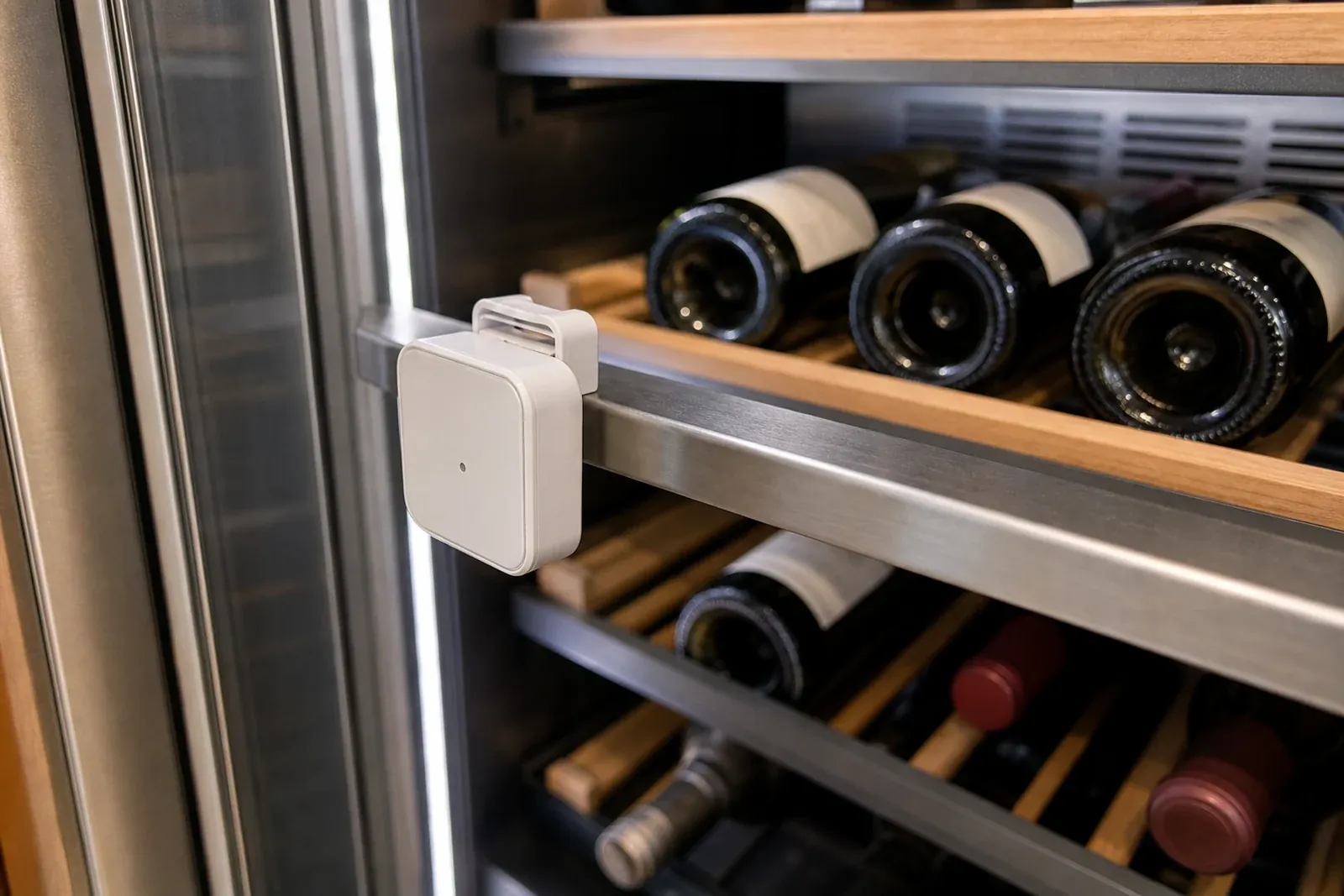
A collector cabinet holds a tight band — often within a few degrees — so a number on the door at the moment we arrive cannot prove or disprove drift. On a single column that is true; across a bank of columns it is decisive, because the displays can disagree by design while the actual bottle temperatures tell a different story. Our standard is a day of logged readings from every zone, placed at bottle height rather than read off the door, then compared against each control board's reported value. A standalone thermometer or a phone-connected logger left in each zone overnight is enough; we will tell you where to place them when you call.
That log separates four things that look identical from the doorway. A genuine sensor or control fault shows as a steady offset on one zone that the board does not agree with. A tired evaporator fan reveals itself as warm upper shelves in a tall column while the bottom holds. A shared-condenser airflow restriction shows as the whole bank creeping up together, usually after a dusty or smoky stretch. And a simple environmental spell — a heat wave, a door propped open during a party, an HVAC supply routed too close to the cabinets — shows as drift that recovers once the cause passes. We do not name a part for an estate installation until the data says which zone, and which of those four causes, is actually real.
This verification-first approach is also what protects you from paying to replace a healthy unit. On a four-column wall, condemning the wrong column means moving and reseating a heavy, panel-matched cabinet for nothing, and possibly disturbing bottles that were never at risk. The log is the cheapest insurance against that.
Patterns we see
How multi-zone faults read across Fountaingrove and Bennett Valley installations
Across larger Sonoma County wine installations a handful of patterns repeat. The table maps what you observe to where the fault usually lives and a planning range — each one confirmed on site against your zone logs, model and serial before any part is ordered. Read it as a starting point for the conversation, not a self-diagnosis: the same warm zone can be a sensor on one model and an airflow damper on another, which is exactly why the model and serial matter. Note that a whole-cabinet sealed-system failure is the rarest outcome on these calls, not the first one we reach for.
| What you observe | Where the fault usually lives | Planning range |
|---|---|---|
| One column warm, neighbors hold their band | Thermistor, evaporator fan or control on that single unit | $300–$560 |
| Warm upper shelves, cool lower (tall column) | Evaporator fan, damper or airflow stratification | $320–$580 |
| Whole bank drifts after a heat wave or smoke event | Shared-condenser dust/ash load; clean and re-measure | $120–$320 |
| Humidity off — dry corks or condensation in one zone | Door seal, gasket compression, panel reveal | $260–$540 |
| Two zones in one column disagree by design | Dual-zone damper or zone sensor, not a failure | $300–$620 |
| Multiple zones warm with long, constant runs | Sealed system on the affected unit (verified) | $900–$1,800 |
Humidity & the band
Holding humidity and temperature together across a cellar wall
Temperature is only half of what a collection needs. A wine installation that holds the right degrees but lets humidity wander will dry corks over years — risking seepage and oxidation on bottles meant to age — or bead condensation on the glass and shelving. On a multi-zone wall this rarely happens uniformly: one badly sealing door can pull the humidity envelope off in a single zone while the rest read perfectly fine. So we check the seal and humidity behavior of every door, not just the one that looks suspect, and we read humidity as a property of each zone rather than the room.
Santa Rosa's hot, dry inland summers push hard against a wine band. Kitchen air that meets a cold door edge with weak gasket compression sweats and drips; a long-open door during entertaining dumps warm, dry air into a zone and then takes hours to recover. On panel-ready installations common in Fountaingrove and Oakmont remodels, a heavy matched wood panel can tug a door's alignment slightly out of true over time, so the magnetic gasket no longer compresses evenly along its full length — and that uneven seal is felt as a humidity problem long before it looks like a temperature one.
The fix is almost never to turn the whole bank colder, which only invites condensation and stresses every compressor. It is to restore even seal compression on the specific door, correct the hinge or panel reveal that pulled it open, and re-verify that the zone holds both its temperature and its humidity envelope afterward. Where dust and wildfire ash have loaded a shared condenser, clearing that airflow path is part of the same visit, because a coil working too hard makes every humidity and temperature problem on the bank worse.
Sparkling and long-aging reds are the most sensitive to all of this, so on mixed installations we pay closest attention to the zones holding them. A few percent of humidity wander a collector might never notice on a daily-drinking white can, over a decade, be the difference for a cellared bottle — which is exactly why measuring and protecting each zone individually, rather than treating the wall as one box, is the whole point of this service.
Protect the collection
Collection-safe handling and estate scheduling
For an installation holding a real collection, the diagnostic itself has to be safe. We work to keep bottles undisturbed and zones closed as much as possible, log before we intervene, and stage any cabinet-safe pullout so adjacent columns and matched panels are protected — the same discipline described on our cabinet-safe service page, applied to a wall of wine rather than a single refrigerator. When one unit in a bank needs deeper work, we sequence the visit so the surrounding columns keep cooling and the collection never sits unprotected.
Estate logistics are part of the job, not an afterthought. Many Fountaingrove, Skyfarm and Bennett Valley wine installations sit at the back of long driveways or up hillside parking, so we book a longer window and ask about access — gates, stairs, tight butler's-pantry clearances — at intake. That up-front detail is what lets the right parts and the right number of hands be on the truck for a bank, instead of a return trip.
- Per-zone logging arranged ahead of the visit so the diagnosis starts from data, not guesswork at the door.
- Genuine Sub-Zero OEM parts for any sensor, fan, damper, gasket or control board, with a flat quote approved before any work begins.
- Cabinet- and collection-safe handling of matched panels and neighboring columns whenever access is needed.
- Diagnostic $95–$150, credited toward the repair once you approve it; most multi-zone repairs land in the $300–$900 range, with verified sealed-system work the exception.
If you are weighing whether a years-old installation is worth keeping, the math on a built-in is rarely just the appliance price — cabinetry, matched panels and water lines all factor in. See repair vs replace before assuming a whole-wall replacement, and call (628) 209-6820 to get a verification-first assessment of your specific installation.
Next step
Call with the Sub-Zero model number
Have the model-tag photo, current fresh-food and freezer temperatures, and the symptom timeline ready. That lets the Santa Rosa intake route the visit around the likely Sub-Zero part family instead of a generic appliance script.
FAQ
Questions Santa Rosa homeowners ask before scheduling
Who repairs large or multi-zone Sub-Zero wine installations in Santa Rosa?
We do, as an independent Sub-Zero built-in specialist serving Fountaingrove, Bennett Valley and the rest of Sonoma County. Paired columns, dual-zone units and built-in cellar walls are diagnosed zone by zone from logged readings, not from one door display. Book at (628) 209-6820.
Why log every zone before you come out to my wine cellar?
On a bank of columns the displays can legitimately disagree, so a single snapshot cannot prove which zone is actually drifting. A day of bottle-height readings from each zone separates a real sensor or fan fault from a hot week or a door left open at a party, which keeps the repair accurate and the collection safe.
How much does it cost to service a multi-column wine installation?
Most multi-zone wine work runs $300 to $900 depending on whether it is a sensor, fan, damper or seal, with the $95 to $150 diagnostic credited toward the repair. Only a verified sealed-system failure on one unit reaches $900 to $1,800 — and that is the rarest outcome, confirmed with gauges and amp draw, never the first guess.
My wine cellar holds temperature but the corks are drying — what is wrong?
That usually points to humidity, not temperature. On a multi-zone wall one door with weak gasket compression can pull the humidity envelope off in a single zone while the others read fine. The fix is restoring even seal compression on the affected door, common in dry Santa Rosa summers, rather than making the whole bank colder.
Should I shut down a whole bank of columns if one unit is running warm?
No — leave the others running. Shutting the bank down resets the evidence and needlessly warms a sound collection. Keep the affected zone closed, note when the drift started, and book a diagnostic; we plan the visit so the healthy columns keep cooling while we address the one that is off.
Do you service built-in wine cellar walls and panel-ready installations in Fountaingrove?
Yes. Panel-ready and banked installations are common in Fountaingrove and Oakmont remodels, where a heavy matched panel can pull a door's alignment and seal. We handle these cabinet-safe, protecting adjacent columns and matched panels, with estate access and a longer window noted at intake.
Related