Santa Rosa · Mark West Springs / Riebli Valley foothills
Prepping a Mark West Springs and Riebli Valley Sub-Zero call so one trip finishes the repair
Out past the city grid, a Sub-Zero call is a logistics problem as much as a refrigeration one. The drive up Mark West Springs Road and into Riebli Valley is long, the cabinetry hides the condenser behind custom grilles, and a missing part means a second trip across town. This page is the prep list that lets a far visit close in one stop.
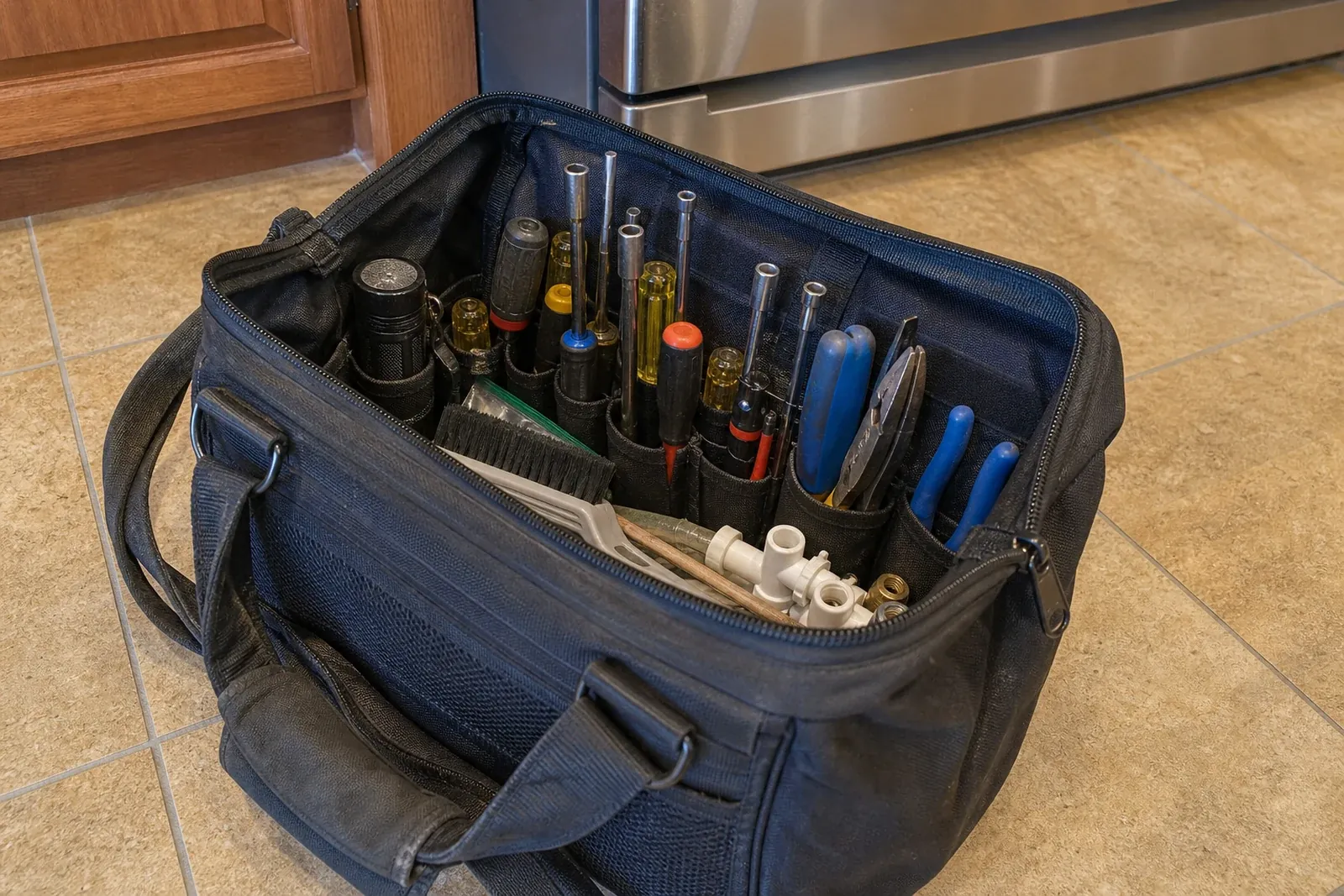
Direct answer
To finish a Mark West Springs or Riebli Valley Sub-Zero repair in one trip, photograph the model tag, the condenser grille, and the symptom, then clear a path to the unit before arrival. That lets the technician load likely parts for the drive up the foothills instead of returning. Send photos when you book at (628) 209-6820.
Why distance changes the call
A foothill address turns a repair into a one-trip problem
In the central Santa Rosa grid, a forgotten part is a twenty-minute round trip to the van or a supplier. Up Mark West Springs Road, around the Riebli Valley bends, and into the parcels above the Mark West Creek corridor, that same gap can cost the better part of a day. The road climbs, narrows, and loops back on itself, and the homes sit on long private drives behind gates and cattle guards. A second visit is not a small inconvenience here; it is a separate dispatch.
That is the whole reason this page exists. Everything below is aimed at one outcome: giving the technician enough evidence before arrival to load the right parts and finish in a single trip. A Sub-Zero diagnosis is still evidence-first and the flat-rate quote is still approved before any work begins. What changes in the foothills is that the prep you do at home decides whether the correct gasket, fan motor, thermistor, or control board is already on the van when it comes up the grade. We serve the 95403 and 95404 footprint that covers most of this corridor, and we plan foothill routes around the photos you send.
The four-photo packet
What to photograph before a far visit
Four photos do most of the work. They are not a replacement for on-site testing, but they let us pre-stock the truck instead of guessing blind from a phone description. Take them in daylight if you can, and text them when you book.
- The model and serial tag. On Classic BI units it usually hides on the upper-left interior wall behind the grille or inside the fresh-food compartment. The model family (BI-36, BI-42, BI-48, a Designer or PRO column, or a wine column) decides which gasket profile, fan, and board we carry up.
- The condenser grille and what is behind it. Many foothill kitchens were finished with custom wood grilles or integrated panels that disguise the toe-kick condenser. Photograph the grille and, if it lifts off easily, the coil behind it. This is the single most useful image on this corridor.
- The symptom itself. A frost line at a door corner, water under the crisper, hollow ice cubes, a display alarm code, or a thermometer reading sitting in the fresh-food section. Photograph the actual evidence, not just the appliance.
- The approach and clearance. The cabinet reveal, side gaps, and the floor in front of the unit. On long-haul calls this tells us whether a cabinet-safe pullout needs a second set of hands scheduled into the same window.
Custom grilles and hidden coils
Why foothill cabinetry hides the part that matters most
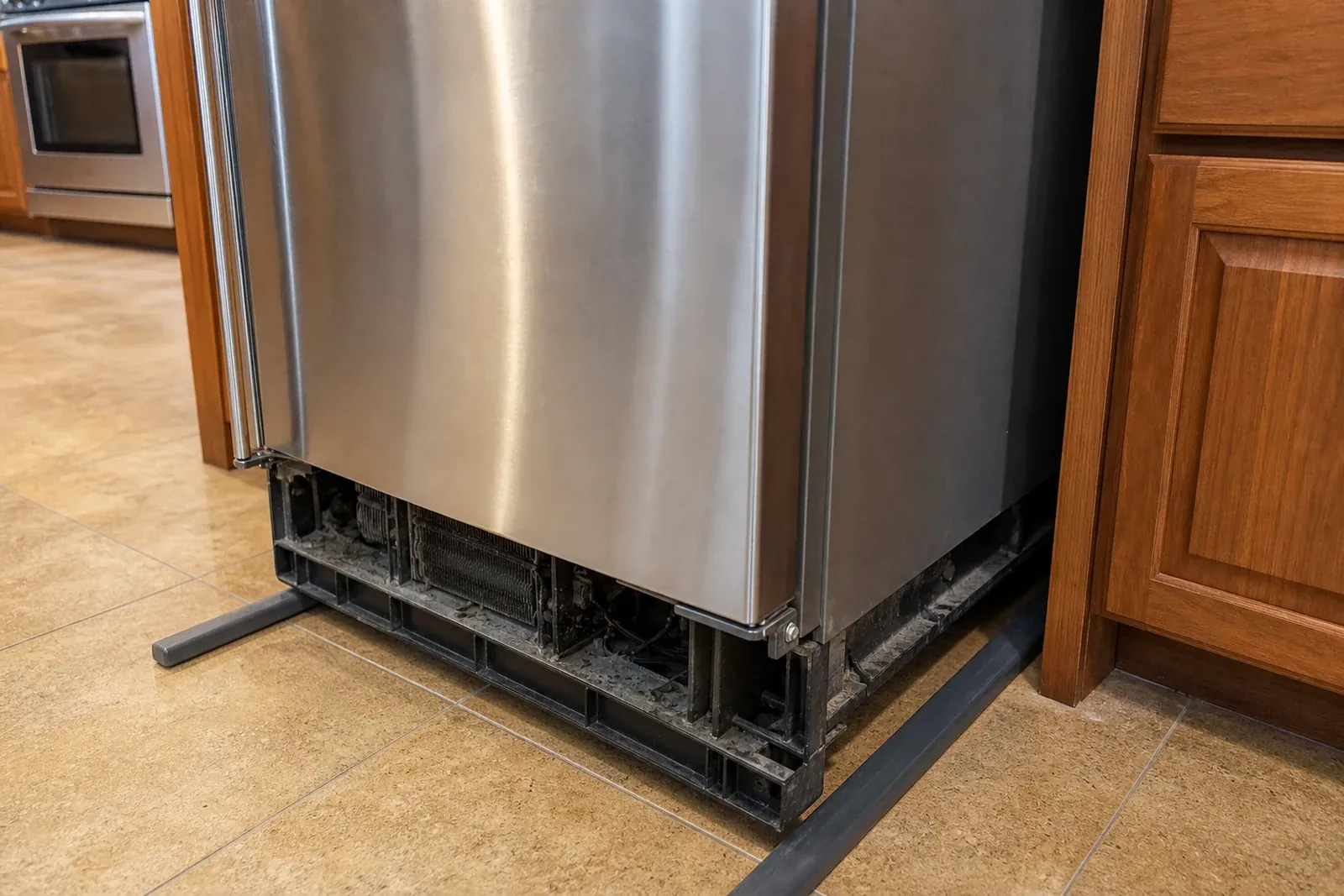
Riebli Valley and Mark West Springs homes lean toward custom millwork. The Sub-Zero was framed into the cabinetry, and the standard toe-kick grille was often swapped for a furniture-grade wood panel that matches the run. It looks beautiful and it buries the condenser. On the dusty inland foothills that is a problem, because the coil is exactly where dry-season dust, road grit off unpaved drives, and wildfire-season ash collect.
A buried, dust-packed condenser is one of the most common reasons a foothill Sub-Zero runs warm or runs constantly. It also imitates bigger failures: a fresh-food section that drifts up a few degrees can look like a sealed-system fault when it is really a coil that hasn't breathed in years. That is why the grille photo matters so much before we drive up. If the grille is screwed in, panel-clipped, or part of a continuous cabinet face, knowing that in advance lets us bring the right access tools rather than improvising at the top of the grade.
The honest part: clearing and reading the condenser is step one, but it is not always the answer. We confirm actual compartment temperatures, fan behavior, and airflow before anyone talks about a compressor or refrigerant. The grille just decides how fast we can get to that evidence.
Stocked-parts risk
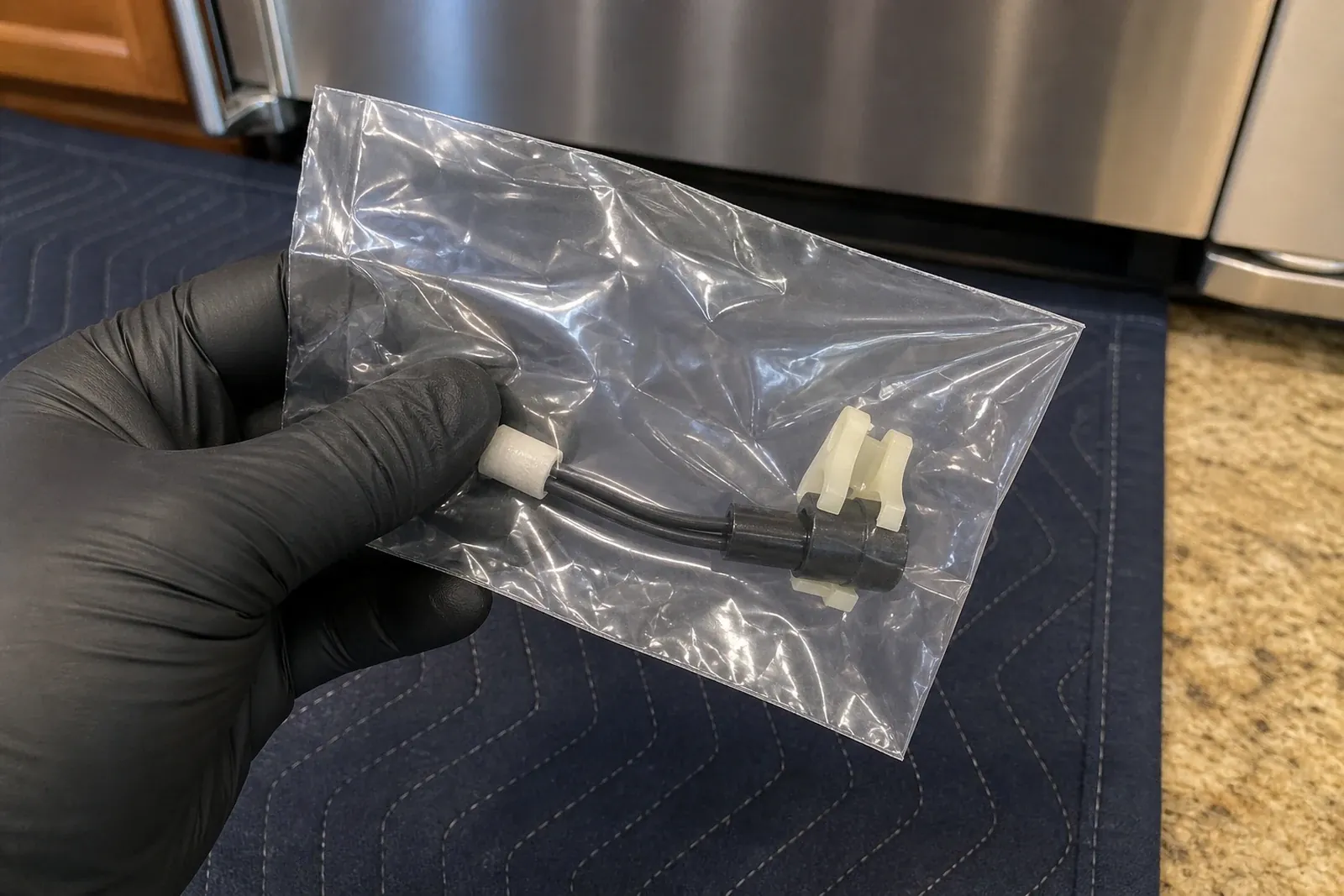
Matching likely parts to the symptom before we load the van
The table below is how we read your photo packet into a parts plan. It is not a quote and it is not a promise of the repair; it is what we stage so a far visit has a real chance of closing the same day. The on-site testing still rules, and the flat-rate price is still approved before work. If the evidence on arrival points somewhere else, we say so.
Sealed-system suspicion is the one category we cannot pre-stock our way around. Refrigerant work needs EPA Section 608 measurement on site before any part is named, and across the older estates up here you'll find R-12 and R-134a systems alongside newer R-600a isobutane units. If your photos suggest a sealed-system fault, we plan the trip as a measured diagnosis first, not a same-day repair, and we tell you that honestly when you book.
One more foothill habit worth naming: we lean toward bringing the model-matched gasket and the common fan and thermistor for your unit even when the photos point elsewhere, because those are small, cheap to carry, and frequently the second issue we find once the cabinet is open. A door that has been pulled out of square by a tight custom panel, plus a coil that has not breathed in years, is a very common pairing in Riebli Valley kitchens. Carrying the gasket up means we are not making a return trip for a part that costs less than the fuel to fetch it. Genuine OEM parts only; we do not fit a near-match that will fail early and force a third visit.
| What you see | Likely cause we pre-read | What we stage for the drive | One-trip outlook |
|---|---|---|---|
| Warm fresh-food, freezer still cold | Dust-packed hidden condenser, evaporator fan, thermistor | Clear/clean coil, fan motor, sensor | Often one trip if coil is the cause |
| Frost line or condensation at a door | Gasket compression, hinge sag, panel reveal too tight | Model-matched gasket, hinge hardware | One trip when model tag is confirmed |
| Hollow or slow ice | Water valve, fill tube, freezer temperature | Inlet valve, fill-tube parts | One trip if water-side, not freezer-side |
| Display alarm or code | Thermistor chain, door history, control board | Sensors; board only after on-site proof | Diagnosis-first; board rarely pre-loaded |
| Both zones warm / constant run | Sealed system, compressor, severe coil blockage | 608 gauges and recovery tools | Measured diagnosis trip, not same-day |
Clearing the path
What to clear before the truck comes up the grade
Foothill visits run on a tight window because of the drive, so a clear approach buys diagnostic time. None of this is heavy lifting; it is removing the small obstacles that otherwise eat the first half hour.
- Gate and drive access. Have the gate code ready, unchain the cattle guard, and confirm whether the van can turn around at the top. A long backing maneuver on a narrow drive costs real minutes.
- The grille and toe-kick. If the custom grille lifts off without tools, set it aside. If it is screwed or clipped, leave it but flag that in your photos so we arrive ready.
- The floor in front of the unit. Clear a runway for a cabinet-safe pullout. On hardwood and stone we still stage floor runners and panel-edge protection, but a clutter-free approach lets that happen quickly.
- Water and power notes. Know where the water shutoff and the dedicated circuit are. On older Riebli Valley homes the shutoff is sometimes outside or in a basement crawl.
- Pets and parking. Foothill properties often have working dogs and loose gravel parking. A planned spot near the door keeps tools close on a long call.
Do this and the technician spends the visit measuring temperatures and confirming the fault rather than negotiating the driveway. The diagnostic is $95 to $150 and credited toward the repair; most built-in repairs land between $200 and $650, with sealed-system work in the $900 to $1,800 range once it is measured and approved.
Dust and the dry-season load
Why the foothills are hard on a sealed condenser
The climate angle up here is not decorative. Mark West Springs and Riebli Valley sit in the hot, dry inland band where summer afternoons load a condenser hard, and the hillside setting adds fine dust off the slopes and the unpaved stretches of private drive. In wildfire season the ash that blankets the corridor settles straight onto intake paths. Hidden behind a custom grille, that buildup is invisible until the refrigerator starts running warm or running without rest. Homes set back from the road also tend to run the kitchen Sub-Zero next to a sun-facing window wall, and that radiant heat stacks onto the same condenser the dust is already choking.
There is a water side to the climate too. Santa Rosa runs moderately hard water, and up these parcels many homes are on wells, which can scale an ice maker inlet valve and shorten filter life to roughly six to nine months. When a foothill call comes in for hollow or slow ice, we read the water history before we read the freezer, because a scaled valve and an exhausted filter are cheaper and faster to settle in one trip than a freezer-temperature chase. That is the kind of detail your photo of the symptom and a note about well versus city water helps us pre-plan.
The practical takeaway for a one-trip call: the condenser is almost always worth clearing and reading first, and on this corridor we treat it as the default opening move rather than a generic chore. It is also why a foothill Sub-Zero benefits from condenser cleaning on a tighter schedule than a coastal or shaded home would. If you are already booking a repair, it is worth asking whether the coil should be cleared in the same visit while the grille is off and the van is up the hill. Pairing the cleaning with the repair is the single best way to keep one foothill trip from turning into two.
Next step
Call with the Sub-Zero model number
Have the model-tag photo, current fresh-food and freezer temperatures, and the symptom timeline ready. That lets the Santa Rosa intake route the visit around the likely Sub-Zero part family instead of a generic appliance script.
FAQ
Questions Santa Rosa homeowners ask before scheduling
Do you actually drive out to Mark West Springs and Riebli Valley?
Yes. The Mark West Springs and Riebli Valley foothills fall inside our 95403 and 95404 Santa Rosa service footprint. Because the drive is long and the homes sit on private drives, we plan foothill routes around the photos you send so the visit is stocked correctly. Call (628) 209-6820 and describe the address access when you book.
What should I photograph so a far visit finishes in one trip?
Four photos: the model and serial tag, the condenser grille (and the coil if it lifts off), the actual symptom, and the cabinet clearance around the unit. Those let us pre-stock likely parts for the drive up. They do not replace on-site testing, but they prevent a blind dispatch and a second trip across town.
Why does my Sub-Zero's custom grille matter for the repair?
Many foothill kitchens replaced the standard toe-kick grille with custom millwork that hides the condenser. On the dusty Mark West corridor that buried coil is a leading cause of warm or constant-running units. Knowing the grille style in advance tells us what access tools to bring so we can reach and read the coil quickly.
How much does a Sub-Zero diagnostic cost up in the foothills?
The diagnostic is $95 to $150 and is credited toward the repair if you proceed. There is no separate distance surcharge buried in the work; the flat-rate repair quote is always approved before anything is done. Most built-in repairs run $200 to $650, and measured sealed-system work runs $900 to $1,800.
Why is my foothill refrigerator running warm in summer?
On the hot, dry Riebli Valley slopes, a condenser hidden behind a custom grille collects dust, road grit, and wildfire-season ash until airflow drops and the cabinet drifts warm. It often imitates a bigger fault. Clearing and reading the coil is our first check before anyone discusses the compressor or refrigerant.
Can a sealed-system repair be done in one trip out here?
Usually not. Refrigerant work requires EPA Section 608 measurement on site before any part is named, and homes up here mix R-12, R-134a, and R-600a systems. If your photos suggest a sealed-system fault, we plan the trip as a measured diagnosis first and tell you honestly rather than promising a same-day fix.
Related